
Proptech in Canada 2026: Future of Real Estate
PropTech, Canada, Real Estate Innovation
Proptech in Canada 2026: What the Data Signals for the Future of Housing
Drawing on the Proptech Collective’s Proptech in Canada report and the latest 2026 market insights, this article explores how Canada’s proptech ecosystem is reshaping housing, investment, and real estate operations; and what it means for the future of housing in Canada.
A maturing proptech ecosystem; fewer bets, stronger companies
Canada’s proptech ecosystem has reached a new phase of maturity. The Proptech Collective tracks nearly 600 active proptech firms nationwide, up from 535 the previous year, with roughly a quarter founded in the past five years. This signals not a speculative bubble, but sustained formation of companies anchored in real operational problems across the real estate lifecycle, from discovery and underwriting to construction and long‑term management (Proptech Collective; NextHome).
This ecosystem is intentionally fragmented, specialized tools for leasing, construction, energy, financing, and tenant engagement, yet increasingly interoperable. For housing stakeholders, that fragmentation is an advantage, not a flaw: it allows cities, developers, and non‑profits to assemble tailored stacks that address specific affordability, supply, and operations challenges rather than adopt monolithic, inflexible systems (home.ca).
Funding statistics — disciplined capital in a tighter market
The funding picture is more sober; and more strategic. In 2025, Canadian proptech companies raised approximately CA$450 million, down from around CA$800 million the year before, with a median raise near CA$3 million (Fintech.ca). Deal volume has fallen from roughly 50 rounds per year at the 2021–22 peak to about 30 in 2025. At first glance, this looks like a pullback; in practice, it is a recalibration toward quality over quantity.
Global data reinforces this pattern. In Q1 2026, global proptech investment reached US$3.3 billion across 125 deals, yet the top 10 transactions captured about 62 percent of capital (CRETI). Canada’s broader tech sector shows a similar dynamic, fewer deals, more selective investors, and a decline in foreign participation (WealthProfessional).
📌 Key takeaway: Capital is tighter; but it is also more purposeful, flowing to companies that demonstrate real‑world traction, measurable impact on costs, and clear pathways to scale in housing and real estate.
Market trends reshaping Canadian real estate; AI, modularity, and integration
Several structural market trends now define proptech in Canada. First, AI has moved from experiment to infrastructure. Across architecture, cost estimation, bid management, and property operations, AI is increasingly described as a “team member” embedded in workflows rather than a standalone tool (Mondaq; Real Estate Magazine). For housing providers, this translates into faster underwriting, more accurate project planning, and proactive maintenance, all critical to delivering units on time and within budget.
Second, modular and prefab construction is moving from niche to mainstream. Partnerships such as Mattamy Homes and Promise Robotics demonstrate how AI‑powered robotics can manufacture building components at scale, improving productivity and lowering per‑unit costs (Mondaq). When combined with supportive capital models, bulk procurement, equipment leasing, and performance‑based land pricing; these approaches directly serve Canada’s housing supply and affordability agenda.
Third, the market is shifting from point solutions to integrated platforms. Agents, asset managers, and developers increasingly prefer unified environments that combine CRM, workflow automation, analytics, and compliance features. This trend is visible in both global entrants and domestic platforms, and it aligns with our perspective at The Future of Housing Org, integration is essential if technology is to meaningfully reduce friction across the housing value chain.
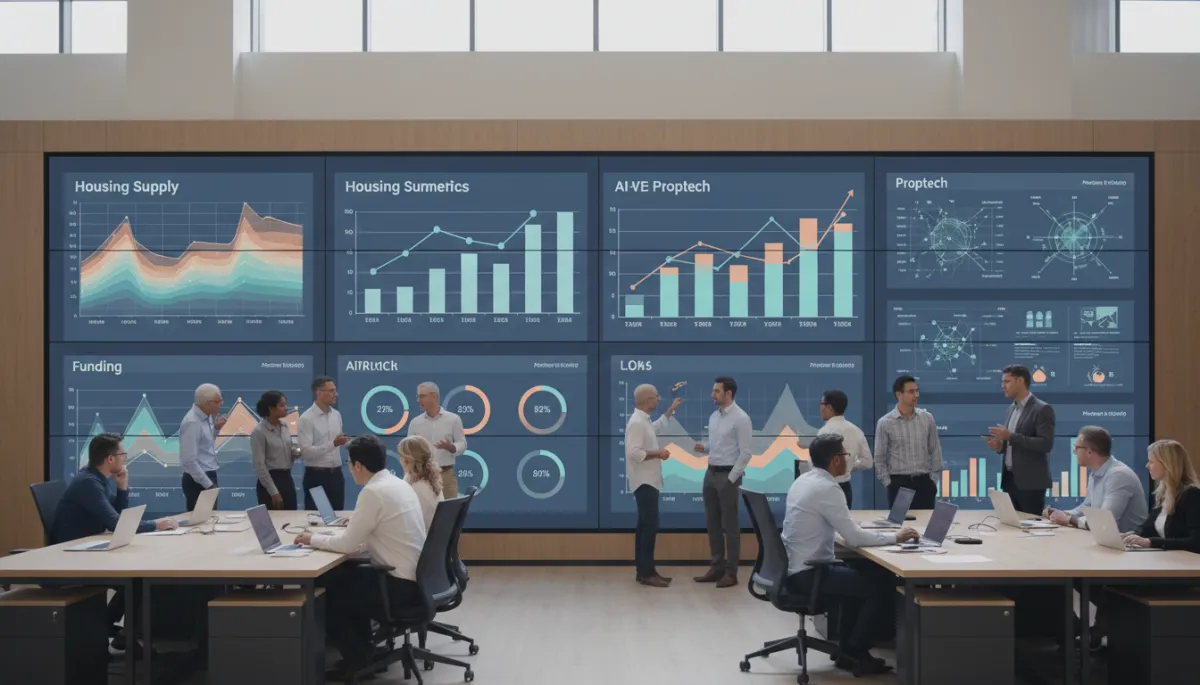
Data-rich proptech dashboards are turning housing strategy from reactive guesswork into proactive planning.
Real estate implications: From pilots to system‑level change
Real estate is feeling these shifts unevenly, but decisively. Regionally, Ontario leads with about 56 percent of Canadian proptech firms, followed by British Columbia, Quebec, and Alberta; more than half of startups cluster in the Greater Toronto Area (Real Estate Magazine). Sector‑wise, roughly 41 percent of companies target residential, 38 percent commercial, and 21 percent construction (Fintech.ca). This balanced distribution matters, it ensures innovation is not confined to luxury assets, but touches everyday rental, ownership, and community infrastructure.
Government initiatives are amplifying these real estate impacts. The federal Build Canada Homes program is deploying more than CA$13 billion to expand supply and modernize construction, particularly through modular approaches, while the Centre for Housing Innovation supports commercialization of housing‑relevant proptech, with multiple cohorts of companies in market (Mondaq). For municipalities and housing organizations, this alignment between innovation, policy, and capital is a rare opportunity, if they are ready to adopt and scale.
💡 Pro Tip for housing leaders: Treat proptech as infrastructure, not accessories — build long‑term partnerships, insist on open data standards, and align pilots with clear affordability and supply outcomes from day one. A practical next step is to join peers and innovators at the upcoming The Future of Housing Org event in Calgary on November 4 & 5, hosted at SAIT, where these system‑level questions will be front and center.
Looking ahead, proptech as a cornerstone of Canada’s housing future
The Proptech Collective’s report, reinforced by 2026 data, tells a consistent story: Canada’s proptech sector is smaller in cheque size, larger in ambition. AI‑enabled workflows, modular construction, integrated platforms, and disciplined funding are converging to reshape how homes are planned, financed, built, and managed. For professionals across real estate, from institutional investors to non‑profit housing providers, the strategic question is no longer whether to engage with proptech, but how quickly and how deeply.
At The Future of Housing Org, we see this moment as a pivotal inflection point. The choices made now, around data governance, procurement, ecosystem partnerships, and equity in access to new tools, will determine whether proptech simply optimizes existing models or truly accelerates a more affordable, sustainable, and inclusive housing system. The technology is here. The funding, while selective, is available. The real work is alignment, and that work starts today, including in convenings like the November 4 & 5 gathering at SAIT in Calgary, where stakeholders from across Canada’s housing ecosystem will chart the next chapter together.
Frequently Asked Questions: Proptech in Canada & The Future of Housing Event
Below are answers to common questions about Canada’s proptech landscape and the upcoming The Future of Housing Org gathering in Calgary.
What exactly is proptech, and why does it matter for housing in Canada?
Proptech (property technology) refers to digital tools, platforms, and hardware that improve how real estate is discovered, financed, built, and managed. In Canada, it now spans everything from AI‑driven underwriting and modular construction to tenant apps and energy‑management systems. It matters because these tools can speed up delivery, lower operating costs, and improve resident experience, all key levers in addressing the housing supply and affordability crisis.
Who should consider attending the November 4 & 5 event at SAIT in Calgary?
The event is designed for public, private, and non‑profit housing leaders, including:
Municipal and provincial housing officials and planners
Developers, builders, and construction leaders (including modular and prefab)
Non‑profit and co‑operative housing providers
Investors, lenders, and impact finance organizations
Proptech founders, product teams, and ecosystem partners
If you influence how housing is planned, funded, built, or operated, you’re the target audience.
What topics will be covered at the Calgary event?
Programming will focus on practical, system‑level questions such as:
How AI and data platforms can shorten project timelines and de‑risk development
Where modular and prefab construction models are already working in Canada
How to structure public‑private partnerships that accelerate supply and preserve affordability
Data governance, open standards, and interoperability across housing systems
Equity and inclusion in access to new housing technologies
📌 Key takeaway: Sessions are designed to move attendees from pilot projects to scalable, repeatable models that materially impact affordability and supply.
I’m a smaller municipality / non‑profit. Do I need a big tech team to benefit from proptech?
No. One of the strongest trends in Canada’s proptech ecosystem is the rise of modular, interoperable tools that can be adopted incrementally. Smaller organizations can:
Start with low‑lift solutions (e.g., digital application portals, basic analytics dashboards)
Leverage vendors that provide “tech‑plus‑service” rather than just software licences
Collaborate with peer organizations to negotiate shared data standards and procurement
The goal is not to become a tech company, but to choose tools that extend your team’s capacity.
How does proptech intersect with government programs like Build Canada Homes?
Federal initiatives such as Build Canada Homes and the Centre for Housing Innovation increasingly expect and support the use of modern construction methods and digital tools. Proptech solutions can help:
Demonstrate compliance and performance for funded projects
Track outcomes like cost per unit, timelines, and energy performance
Unlock new financing models tied to measurable impact
💡 Pro Tip: When applying for funding, explicitly outline how technology and data will support delivery, monitoring, and long‑term stewardship of housing assets.
What are the biggest risks or challenges with adopting proptech?
Common challenges include:
Fragmentation: Too many point solutions that don’t talk to each other
Change management: Underestimating the training and process redesign required
Data governance: Unclear ownership, privacy, and access rules across partners
The emerging best practice is to treat proptech as infrastructure: prioritize vendors that support open APIs, clear data standards, and multi‑year partnerships rather than one‑off pilots.
How can I prepare my organization before attending the event?
To get the most value from the November 4 & 5 convening, consider:
Clarifying your top 2–3 housing challenges (e.g., project delays, operating costs, tenant experience).
Mapping your current tools and data — even a simple inventory helps frame conversations with vendors and peers.
Bringing a cross‑functional team (policy, finance, operations, IT) so decisions can move faster after the event.
📌 Key takeaway: Arrive with a clear problem statement and leave with concrete next steps, partners, and tools to act on it.